
Photography: Richard Waite
The dining room is not always where dinner happens. In Brisbane, that seems especially true. A table may be set beautifully, with candles lit and everything prepared for the evening, yet guests often gather elsewhere first. They stand around the kitchen island, move towards an open door, carry a drink onto the terrace, and eventually find their way back to the table. The evening rarely respects the floor plan.
That is worth attention, because entertaining shows the difference between how a house is imagined and how it is lived in. We design rooms according to function: kitchen, dining room, living room, terrace, each given a name and a fairly clear purpose on a drawing. A good evening is far less disciplined. People gather wherever the conversation is best, wherever the host happens to be, wherever there is somewhere to lean or sit, and dinner stretches on until half the guests drift to the sofa while two people keep talking at the table.
In Brisbane, the climate adds another dimension. For much of the year, the boundary between inside and outside remains remarkably fluid; a terrace is not necessarily the evening’s destination, nor is the interior, and both can be occupied at once. The usual response is to build an outdoor room, effectively duplicating the interior on the other side of the doors. That is sometimes necessary, but entertaining rarely improves simply because every activity has been repeated. What matters more is the relationship between the spaces.
A kitchen separated from the terrace by a difficult route has the host travelling between them all evening; outdoor seating too remote from the interior splits the gathering in two, and a dining table blocking the route to the garden means every movement interrupts someone's chair. These are small inconveniences on a plan. With twenty people in the house, they become the choreography of the evening.
Furniture matters for the same reason. Entertaining is rarely accommodated by dining chairs alone: people perch on a sofa's arm, pull up an occasional chair, or lean against a console. A generous leather ottoman can prove more useful than anything deliberately chosen for the room. That does not mean filling a room with furniture; circulation matters most when a house is full, with enough openness to move and enough structure to settle.
Lighting changes too. The light a chef needs to finish plating is not the light wanted once guests arrive. A house that entertains well needs layers: practical light where required, lower pools of light around seating, light on art, perhaps a glow from the garden beyond. Acoustics deserve equal attention: stone floors and large glazed spaces can be exhausting when filled with conversation, and linen, wool rugs and heavy upholstery do real work by absorbing sound.
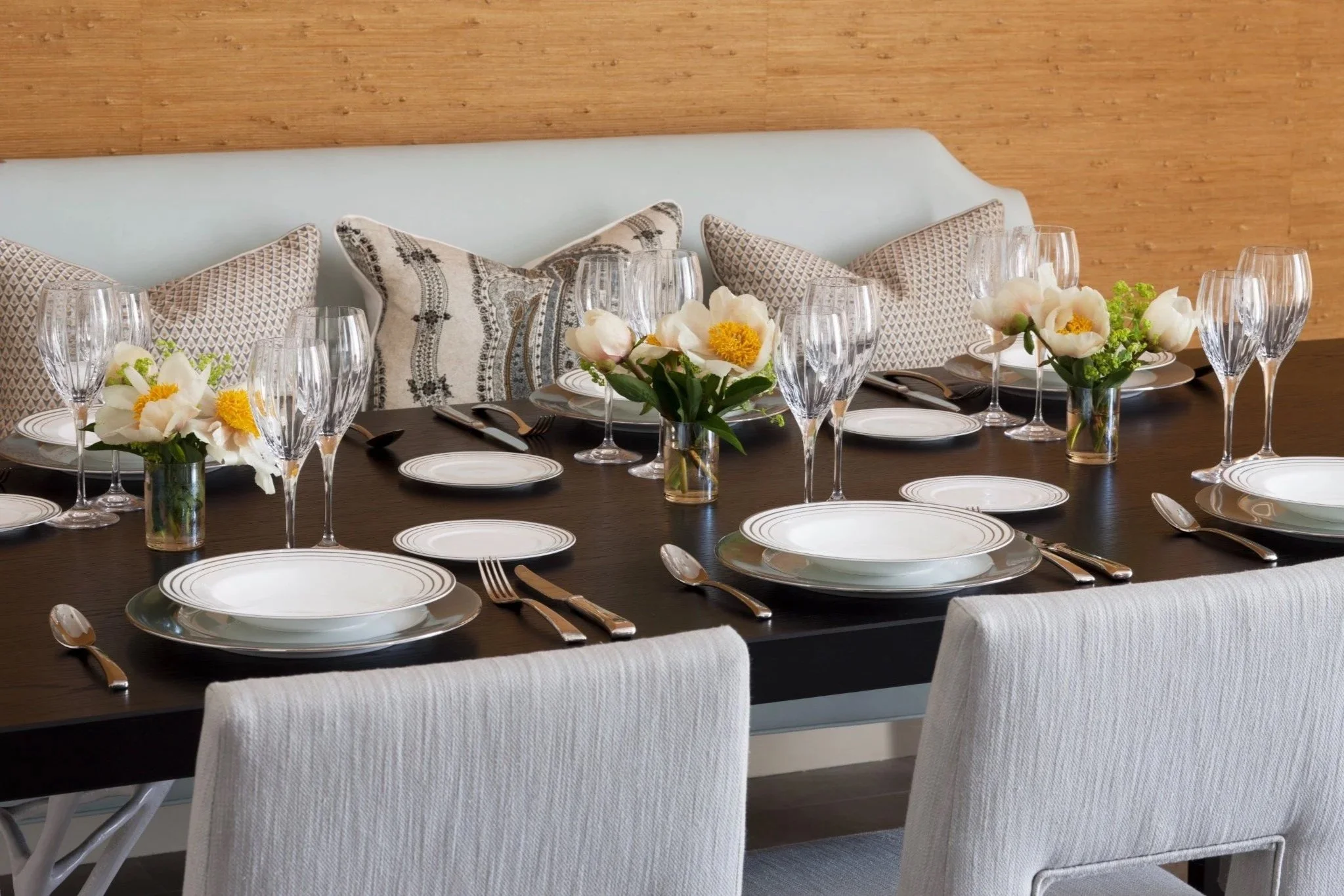
And then there is the question of scale. The rooms that entertain best rarely assume a single gathering size: a banquette that seats six can absorb ten by pulling in occasional chairs from elsewhere, and a bar built to be staffed for a large party runs just as well unstaffed for a smaller one. What changes is not the room itself, but how much of it is used, and that suits Brisbane, where the same room might host four people one week and forty the next.
The dining room still matters, as do the terrace, the kitchen and the sitting room. But their success is not measured by whether guests use each one exactly as intended; it is measured by how naturally the evening flows between them. Houses that entertain well do not dictate where people should gather. They simply make every place people choose to gather feel like the right one.
Daniel Kostiuc Interior Design is a luxury interior design studio based in Brisbane, offering residential interior design and interior decoration across Queensland, Australia and internationally. Services include new builds, renovations and complete furnishing projects, with space planning, custom joinery, bespoke furniture, furniture selection, lighting, art and accessories for high-end homes.