
Photography: Richard Waite
Natural stone has returned to the centre of luxury interiors, and the easy explanation, that fashion simply cycles back to where it started, does not hold up under any real scrutiny. Stone never disappeared from the projects that mattered. What changed is the market around it, which spent two decades convinced that manufactured surfaces had solved a problem nobody actually asked to have solved. Marble and limestone are not enjoying a revival so much as a correction, driven less by taste than by a growing discomfort with the material that promised to replace them.
Engineered quartz built its reputation on consistency, sold as an improvement rather than the compromise it actually was. It spread through kitchens and bathrooms because it behaved predictably: the same veining pattern in Brisbane as in London, batch after batch, with none of the variation a quarry produces. That predictability served volume building well, right up until homeowners started noticing their kitchen looked exactly like the display model at the showroom, and the one three doors down the street.
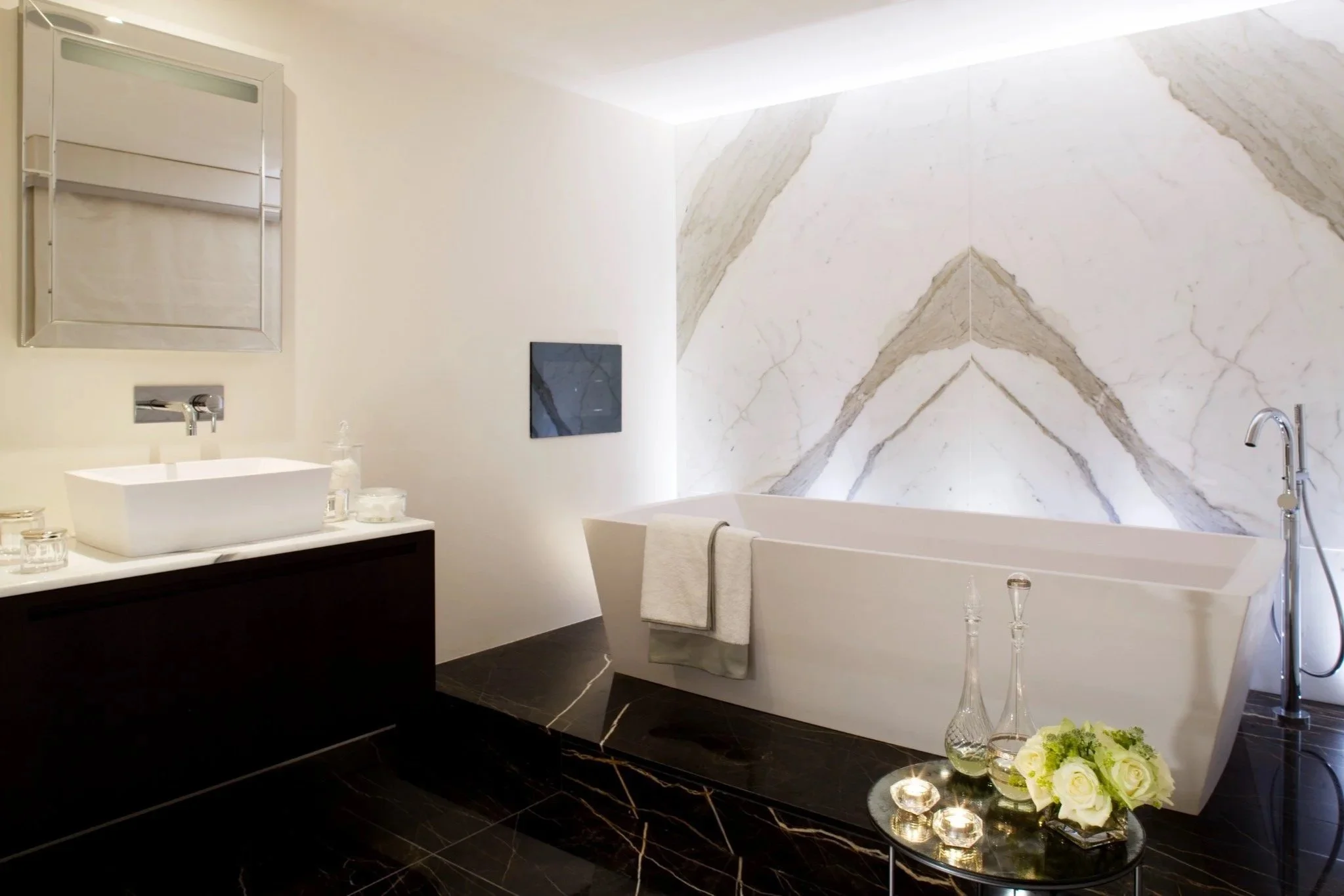
That kind of sameness is precisely the discomfort now pulling clients back toward stone that cannot be reproduced. A slab of Calacatta or Patagonia quartzite carries a pattern that exists nowhere else, cut from a specific block at a specific point in geological time. In a market saturated with identical finishes and templated renovations, a material that is structurally incapable of repeating itself has become the clearest signal a home offers that its interior was actually considered rather than selected from a catalogue.
One recent client came close to making that catalogue selection anyway. A primary kitchen began with a request for engineered stone, chosen for the practical reasons engineered surfaces are usually chosen for: resistance to staining and a finish that would never need resealing. Nothing about that reasoning was wrong. It simply hadn't been tested against an actual slab of stone standing upright under real light, which is a different experience from a sample chip on a countertop.
Seeing the actual stone is what changed the decision. Three quarried slabs were brought into the fabricator's showroom for a side by side comparison against the samples already chosen. The engineered option looked precisely as advertised: even, competent, entirely unremarkable. The quartzite carried a movement across its surface that shifted depending on where a person stood, deep bronze pooling into pale cream in a pattern no two viewings quite repeated. What the client needed had not shifted. What changed was seeing what practicality had quietly been asked to give up.
That trade-off becomes easier to understand once the fabrication side of the shift is considered, since stone has also become considerably easier to work with than it was even a decade ago. Waterjet cutting now produces book-matched joins with a precision that once required a master craftsman's eye alone, and slabs can be honed thinner and sealed more effectively than the technology allowed when engineered surfaces first made their case on durability. The performance gap has narrowed considerably, although the right choice still depends on the particular stone, its finish, the application and the client’s tolerance for maintenance. What natural stone offers beyond performance is a geological history that a surface formed in a factory cannot reproduce.
The same hunger for an unmanufactured history reaches well beyond kitchens and bathrooms. It is the instinct that sends people toward vintage furniture and hand-thrown ceramics, and it is now sending them toward a marble quarried in the Apuan Alps rather than a laminate printed to resemble one. Authenticity has become a luxury in its own right, and stone has the advantage of never having needed to manufacture it.
Stone never had to manufacture that authenticity, which is the real reason its current popularity looks less like a trend than a correction finally working its way through the market. Anyone who specified stone through the years when quartz dominated every renovation show never stopped believing in it. What has shifted is that everyone else has caught up to a material that was quietly right the entire time.
Daniel Kostiuc Interior Design is a luxury interior design studio based in Brisbane, offering residential interior design and interior decoration across Queensland, Australia and internationally. Services include new builds, renovations and complete furnishing projects, with space planning, custom joinery, bespoke furniture, furniture selection, lighting, art and accessories for high-end homes.