
Photography: Richard Waite
A light fixture is judged twice in every room it enters, once as a source of light and once as an object hanging there with the power off, and only one of those judgements is usually made on purpose. Most pendants and chandeliers are chosen for how they look under a showroom spotlight, built to flatter anything hung beneath it. Almost none are chosen for the particular slant of afternoon light they will meet, on the particular wall they will actually face, in the one house they are going into. That gap decides whether a fixture ends up as furniture for the room or as sculpture in it.
Sculpture is the harder test, and it has nothing to do with lumens. Switch the piece off, and it still has to hold the room: cast bronze catching the last of the afternoon light across its surface, mouth-blown glass casting a shadow with a shape worth looking at twice. A fixture built to disappear until switched on fails this instantly. A fixture built as an object first does something else entirely. It sits in a room the way a piece of furniture does, with weight, material, and a specific relationship to the light already in the space, before a single bulb inside it has anything to say.
I watched a stock piece fail exactly this test on a Los Angeles project, in a double-height stairwell built to take exactly this kind of anchor. The client had already bought a chandelier from a lighting showroom's grand-entrance range, a tiered crystal piece cut to catch a ring light in a product photograph. Hung against real, changing daylight from a side window, it read as generic within a week, the kind of piece a dozen other stairwells built the same year were hanging at the same time, all chasing the same effect.
We had it replaced with a piece commissioned directly from a glass fabricator, mouth-blown rather than cut, scaled to the exact width of the stair void and to the angle at which the afternoon light actually crossed it. The bronze armature was left to darken on its own rather than being lacquered bright, since a fixture that earns its patina outlasts one that arrives already finished. Within a season, the stairwell stopped announcing that a fixture had been installed and began behaving as though the room had simply grown a piece of sculpture at its centre.
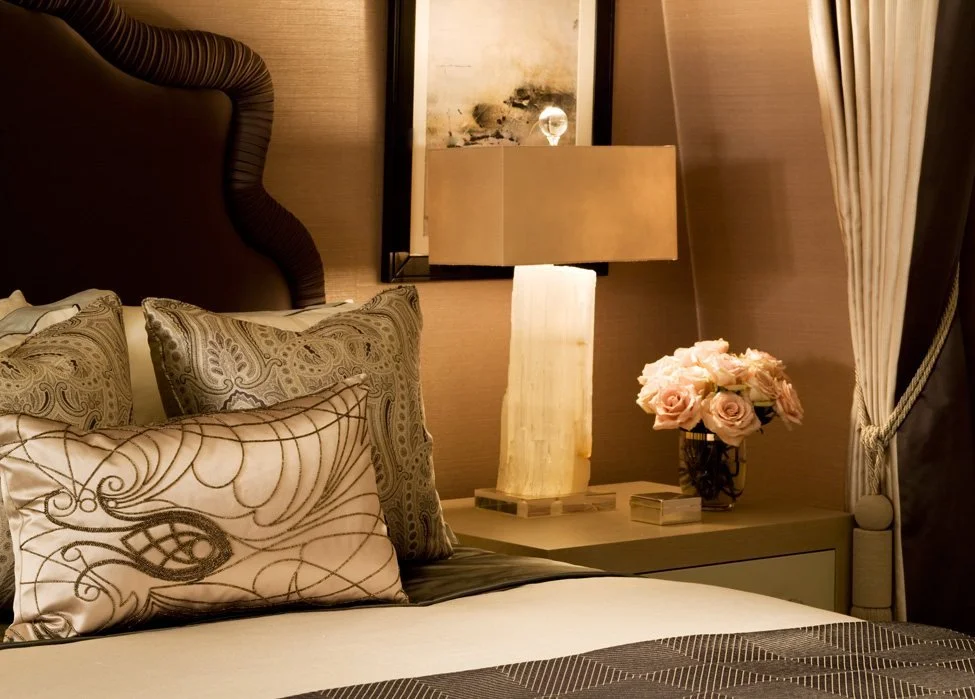
Material carries almost the entire argument here. Mouth-blown glass holds small irregularities that scatter afternoon light differently hour to hour, whereas a mould-cast equivalent throws the same flat pattern every time, regardless of the hour. Bronze develops a patina no factory finish can convincingly fake. A base cut from alabaster or set with rock crystal carries a density in the hand that plated metal never approaches, at any price. None of this shows up in a catalogue photograph. It only becomes legible once the piece is hanging in the exact room it was made for.
Scale and placement are decided the same way a sculptor decides them, by sightline rather than convention. A fixture centred over a table by measurement alone often looks slightly off from the sofa across the room, or from the top of the stairs looking down into it. Those secondary sightlines matter as much as the one a floor plan tends to privilege, and getting them right means standing in every position a person will occupy in that room before the piece is ordered, not after, once it is already hanging and already wrong.
Choose a fixture this way, and it stops behaving like a consumable, swapped out the moment a trend passes or a bulb type is discontinued. It keeps passing the same test year after year: switch it off, walk back into the room, and the space still holds its shape around it, exactly as it did when the piece was first installed.
Daniel Kostiuc Interior Design is a luxury interior design studio based in Brisbane, offering residential interior design and interior decoration across Queensland, Australia and internationally. Services include new builds, renovations and complete furnishing projects, with space planning, custom joinery, bespoke furniture, furniture selection, lighting, art and accessories for high-end homes.