
Photography: Richard Waite
The home office has become public again. For centuries, it was exactly that. The study or library was one of the most public rooms in the house, where a host received visitors and where books, furniture and collections quietly demonstrated education, taste and judgement. Industrialisation reversed that relationship. Work moved out of the home, and the room that remained became private: a place to read, write and concentrate, closed to guests as often as it was closed to family.
Work has now returned to the house, bringing an audience with it. Clients, colleagues and collaborators no longer arrive through the front door. Instead, they see the same carefully framed view of a room through a laptop camera, often long before they meet its owner in person. The home office has quietly resumed its role as a public room, though most homes have yet to recognise the shift.
The design challenge is that there is no established model for it. A private office is judged almost entirely by the person using it. It needs sufficient storage, good task lighting, and comfortable seating to support a workday. An office that is repeatedly seen by others has another responsibility. It contributes to first impressions, credibility and professional identity. Yet the most common response has been to avoid the issue altogether, using a blurred background, virtual scenery, or a blank wall. These conceal the room rather than asking what the room itself ought to communicate.
A Brisbane client illustrated the change particularly well. The brief initially seemed straightforward: a generous desk, good natural daylight and a door that could be closed during meetings. For many years, that would have been enough. As we talked, however, it became clear the room was expected to serve two distinct roles. It needed to function as a quiet place to work while also forming part of the client's professional presence. Every video meeting presented the same carefully composed view to colleagues and clients across different cities and time zones. The original brief described how the room would be used. It said very little about what the room itself would be saying.
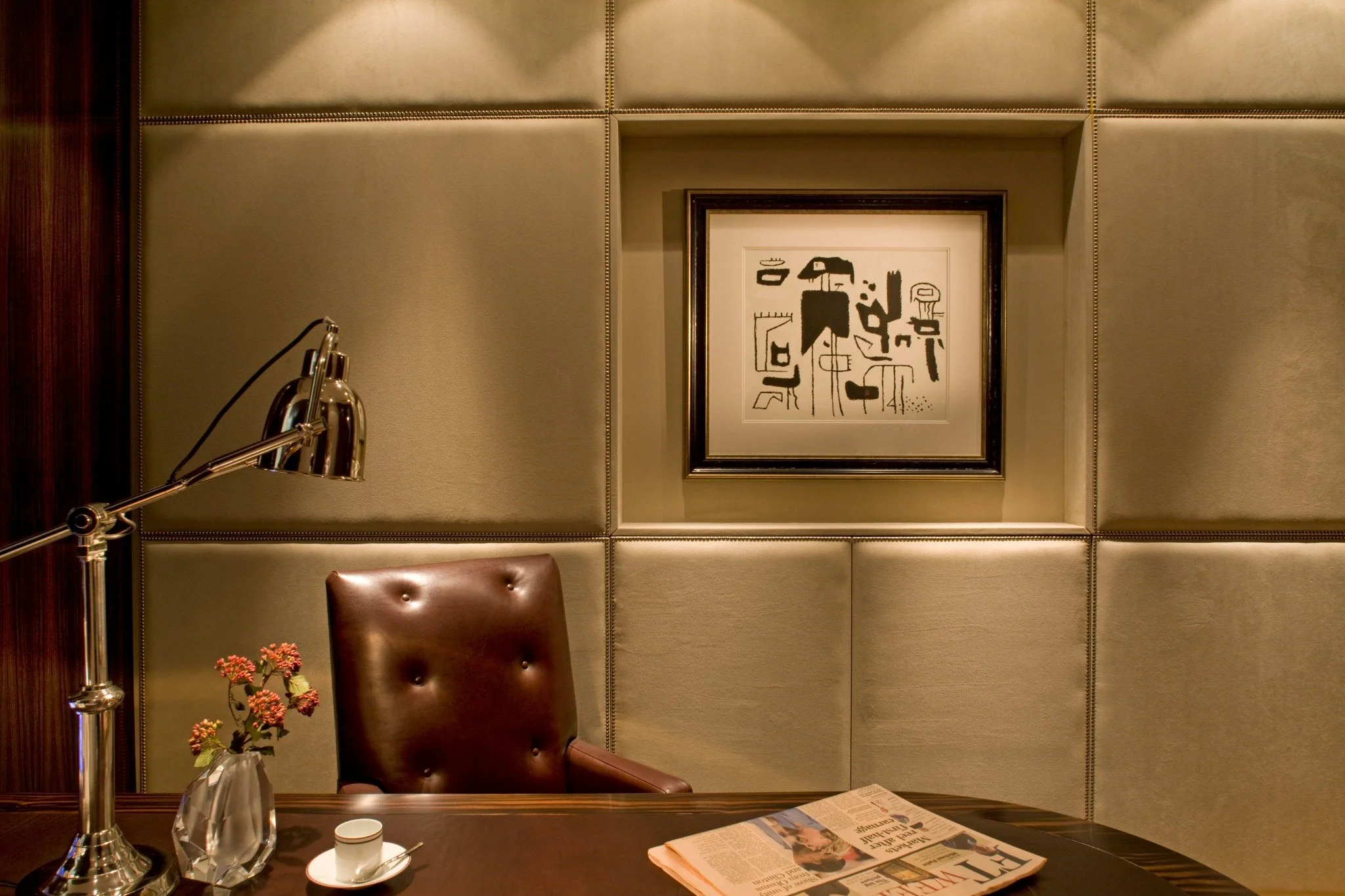
The completed office was designed for two audiences: the person at the desk and the unseen audience beyond the camera. American oak joinery displayed books and collected objects rather than files, creating a backdrop that felt personal without appearing staged. The desk was positioned to capture natural daylight while avoiding direct backlighting during calls. Acoustic wall panels, upholstered in the same wool as the adjoining reading chair, softened the room visually while keeping conversations private in both directions. None of these decisions was dramatic, yet together they acknowledged that the room would be experienced in two entirely different ways: from within it and through a screen.
This is what distinguishes today's home office from the study of twenty, or even ten, years ago. It no longer serves only the person working there. It has become a room that represents its occupant, often to people who will never visit the house. For many professionals, colleagues and clients now see this single view more often than any other part of the home. It is, in effect, the most public room in an otherwise private house.
Interior design has long distinguished between rooms for public life and those reserved for private life. The contemporary home office belongs to both categories at once. Treating it as the spare room, furnished last and considered least, no longer reflects the role it plays. It deserves the same architectural thought once given to the library or drawing room, not because guests will walk into it, but because it has once again become part of how a home introduces the person who lives there.
Daniel Kostiuc Interior Design is a luxury interior design studio based in Brisbane, offering residential interior design and interior decoration across Queensland, Australia and internationally. Services include new builds, renovations and complete furnishing projects, with space planning, custom joinery, bespoke furniture, furniture selection, lighting, art and accessories for high-end homes.