
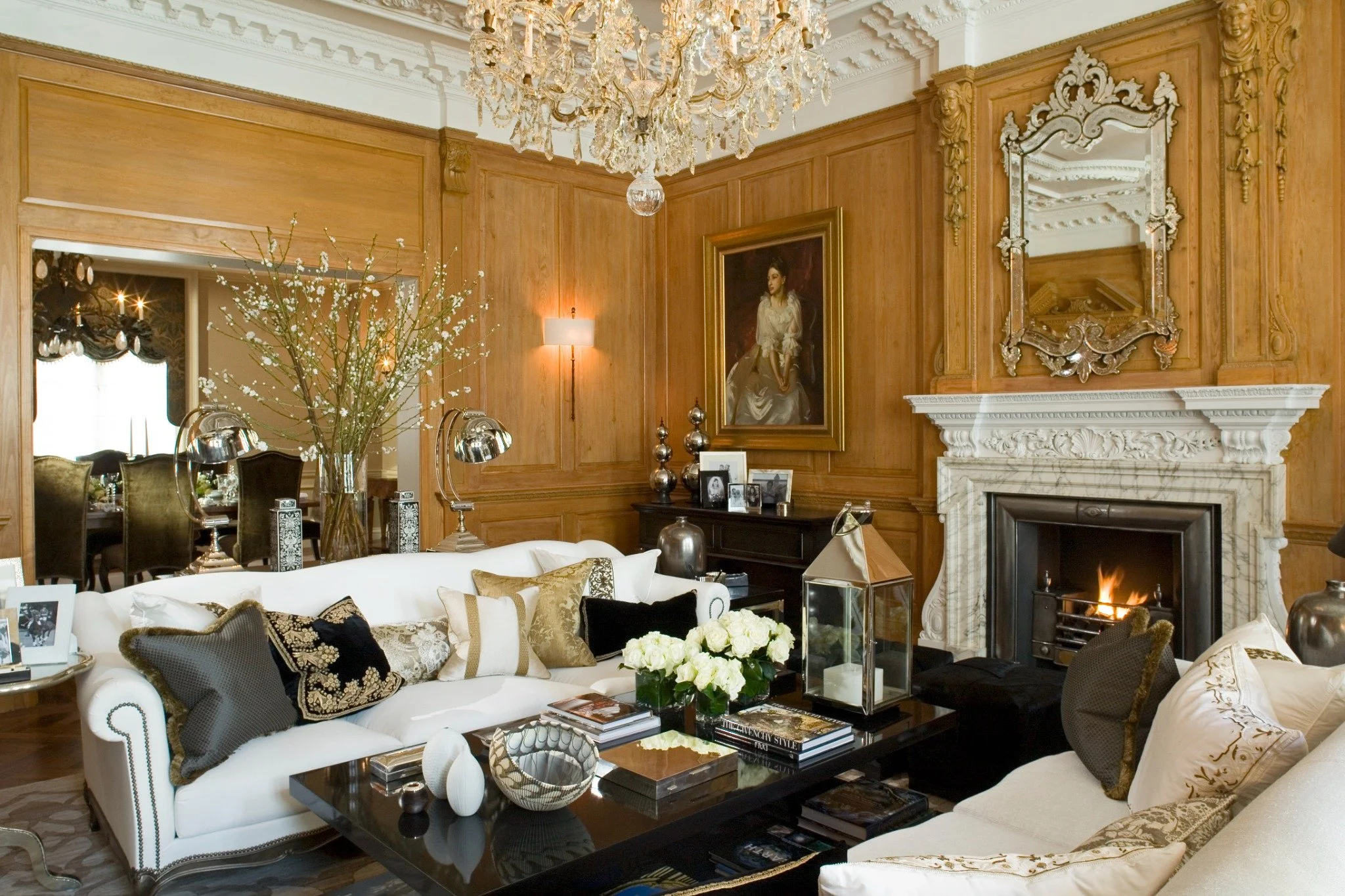
Photography: Richard Waite
An exceptional house often reads as the product of a single unified vision. It is, of course, nothing of the sort. It is the work of many different people. Architects, builders, joiners, stonemasons, upholsterers, metalworkers, lighting specialists, decorative artists, furniture makers, curtain makers and many other craftspeople may all contribute to a complex residential project, each bringing a particular expertise. The difficulty is that the client should not experience the finished house as a collection of separate decisions; it has to feel like a single interior, and that coherence is one of the less visible responsibilities of the designer.
A stonemason may focus on an elegant way to fabricate an edge, while a joiner considers construction, tolerances and movement. A lighting designer thinks about beam angles and output; an upholsterer, how a textile behaves over a particular form. All of them may be entirely correct within their own discipline, but somebody still has to understand what happens when those decisions occupy the same room. This is where coordination becomes more than administration.
The real question is not just whether the pieces fit together technically, but whether they belong together visually, materially and conceptually. A beautiful bronze finish can still be wrong if it competes with a nearby metal, just as a carefully made piece of joinery can feel heavy if its proportions do not relate to the architecture. Even a technically precise lighting solution can diminish a room if the fittings become more noticeable than the objects they were meant to illuminate.
Individual excellence, on its own, does not produce a coherent whole; it has to be directed. That does not mean prescribing every solution for every craftsperson. Some of the best results come from allowing specialists to contribute their knowledge early enough to influence the design. But collaboration only works when the central idea remains clear; without that clarity, specialist contributions can pull in different directions, and each decision may be impressive on its own even as the house gradually loses its voice.
I think of the designer less as the author of every note than as the person responsible for the composition. You have to know when a room needs another layer and when it already has enough, when a maker should be given freedom and when a particular proportion cannot be altered, when an unexpected suggestion improves the original idea and when it merely competes with it for attention. There is also a practical dimension to this orchestration.
A decision by one specialist often affects several others: a change to joinery may alter lighting positions, a revised stone thickness can affect adjacent metalwork, and a furniture dimension can influence electrical locations, rugs and circulation. The project therefore develops as a network of relationships rather than a sequence of isolated objects. When those relationships are managed well, the complexity disappears from the finished room.
You see the stone, but not the discussions required to resolve its junction; you use the cabinet without ever considering the coordination behind it; you sit beneath a pool of light without noticing the work it took to position it precisely. That invisibility is part of the achievement. The purpose of that coordination is to make the result feel natural, not to make the client aware of how difficult it was to produce.
A great house may be made by dozens, sometimes even hundreds, of people, but when all that work is guided by a coherent idea, the finished interior speaks with one voice.
Daniel Kostiuc Interior Design is a luxury interior design studio based in Brisbane, offering residential interior design and interior decoration across Queensland, Australia and internationally. Services include new builds, renovations and complete furnishing projects, with space planning, custom joinery, bespoke furniture, furniture selection, lighting, art and accessories for high-end homes.