
Photography: Richard Waite
There comes a point in almost every exceptional interior when the search must end.
You have looked at the available tables, chairs, consoles, joinery pieces, lights, fabrics, and wallcoverings. Some are beautiful. Some are almost right. But almost right is often the problem. The dimensions are wrong for the architecture. The material introduces a note that belongs somewhere else. The silhouette interrupts a sightline. Or the piece simply does not suit how a client lives.
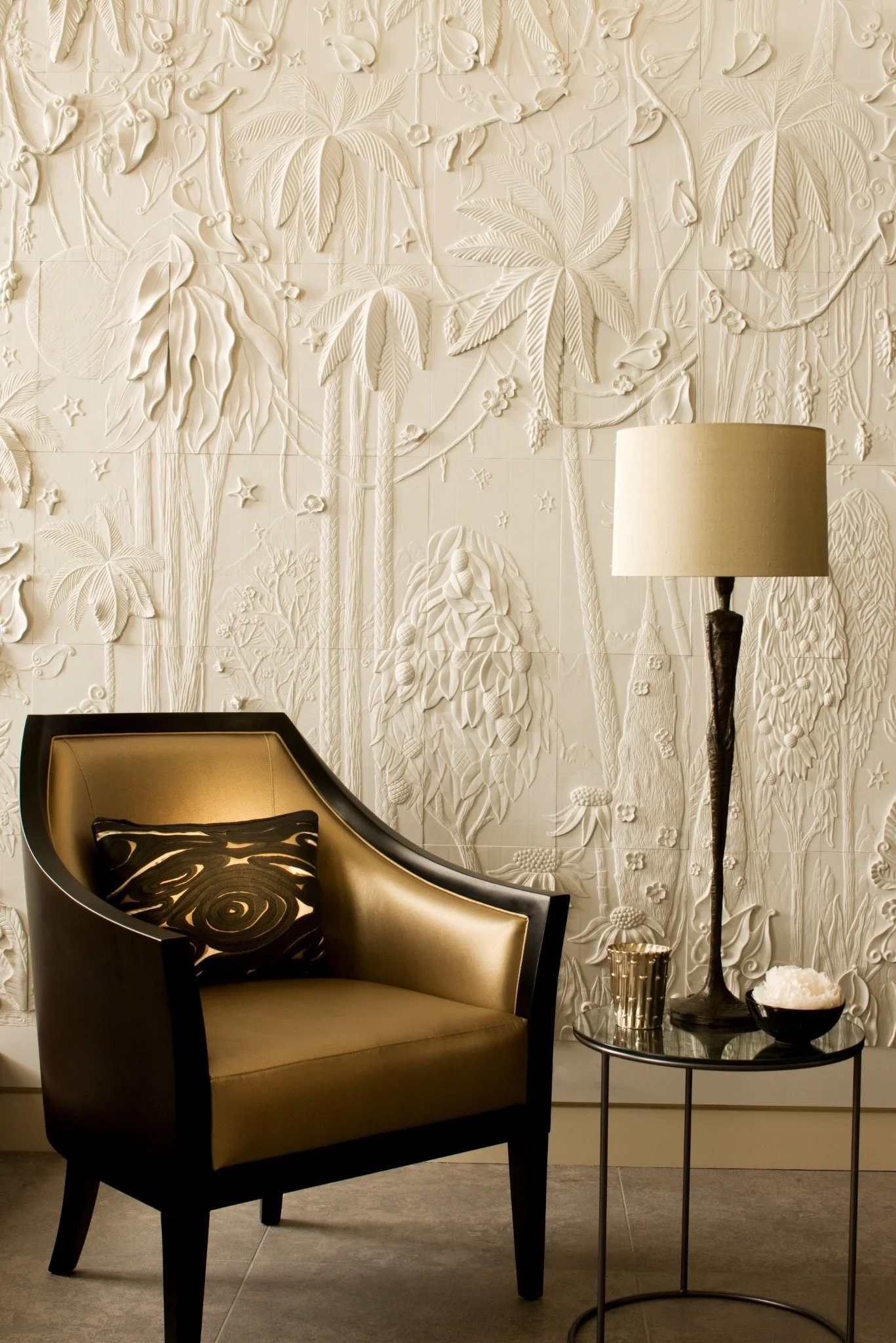
That is usually when a bespoke material or object begins. Not with the desire to make something unique for its own sake, but with the recognition that the room is asking for something that does not yet exist.
Reupholstering a frame in a different fabric, or stretching a cabinet by ten centimetres, can solve some of these problems. But at a certain point, there is no existing object to adapt. The piece must be conceived from nothing, in response to this room, this client and this way of living. It will exist nowhere else.
A dining table is a good example. Its dimensions cannot be considered in isolation from the surrounding room: how many people will sit there, how much space is needed behind each chair, where the doors and circulation routes run, and what the table looks like from the entrance and from the room beyond.
Then there is the human dimension. A table has to accommodate knees and elbows as convincingly as it accommodates architecture. A chair has to support a body, not merely look good in photographs. A bedside table needs to suit the mattress height, the reach of the person using it and the objects that accumulate there each night.
Bespoke design sits at the intersection of those conditions.
This is why I am wary of treating bespoke pieces merely as an extravagance, as symbols of luxury. Their value is not that nobody else owns them. Their value lies in being designed in response to something specific.
There is, though, a second reason bespoke pieces are made, and it has little to do with practicality. Some rooms would function perfectly well with a bought piece. Yet the client still commissions a piece that has never existed before.
That deserves to be taken seriously, not dismissed as indulgence. A one-of-a-kind piece becomes the table a guest asks about, the piece a family gathers around for three generations. What is being commissioned is not only an object but a story, crafted once for this house and no other.
Sometimes the intervention is substantial. A piece of furniture may need an entirely new proportion, construction or material language.
Sometimes it is almost invisible. A console becomes twenty millimetres shallower, making circulation effortless. A handle is moved because that is where the hand naturally falls. A cabinet is divided according to what will actually be stored inside it, rather than an arbitrary symmetry in its elevation. These decisions rarely announce themselves. That is precisely why they matter.
The best bespoke pieces feel inevitable, as if the room could not be imagined without them. They do not seem to have been inserted into the architecture. They belong to it. Achieving that apparent simplicity requires considerable work.
There are drawings, prototypes, material samples, and conversations with makers. Proportions are adjusted; junctions reconsidered. A beautiful idea on paper may prove uncomfortable at full scale. The process is iterative because the object has no precedent. You are not selecting a finished answer. You are discovering it. That is perhaps the most significant distinction between buying and designing.
Selection asks: which of these objects is best? Design asks a different question: what does this particular place require? Sometimes the answer already exists. And sometimes the right object is the one yet to be made.
Daniel Kostiuc Interior Design is a luxury interior design studio based in Brisbane, offering residential interior design and interior decoration across Queensland, Australia and internationally. Services include new builds, renovations and complete furnishing projects, with space planning, custom joinery, bespoke furniture, furniture selection, lighting, art and accessories for high-end homes.