
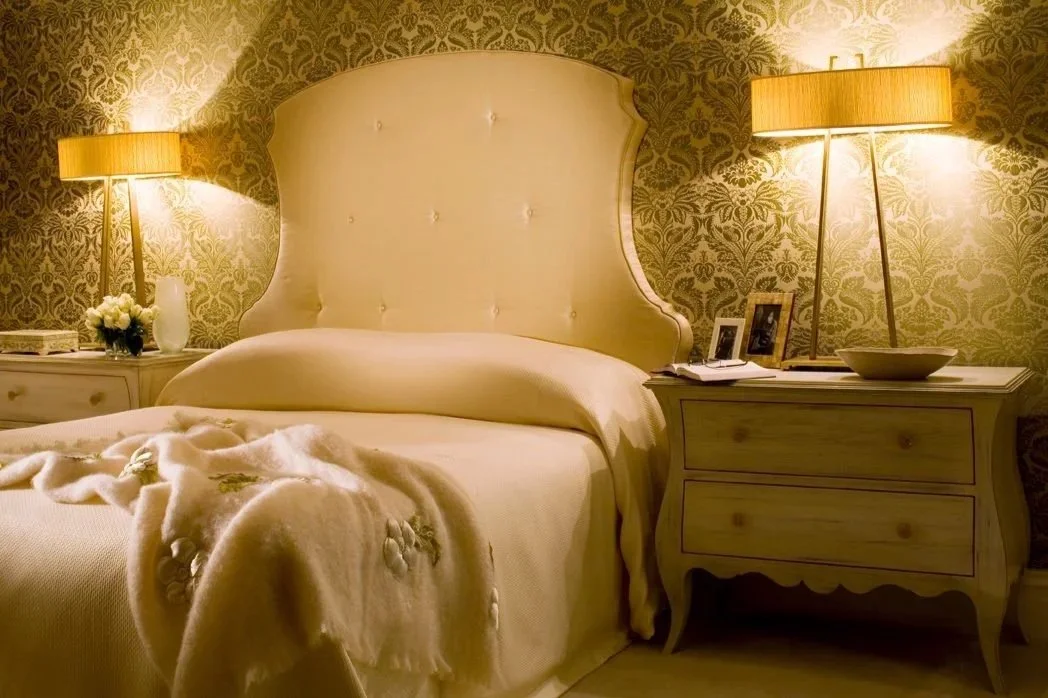
Photography: Richard Waite
Los Angeles taught me to be decisive. London taught me that deciding not to do something can require just as much conviction. I moved to London in 2008 and spent the next chapter of my career working on high-end residential interiors in Britain and internationally, first as Creative Director and then as Managing Director at Intarya. The projects grew larger and more complex, but another change mattered just as much. I began working with buildings that already had considerable character of their own. Historic houses are very good at exposing a designer’s ego.
A room may already contain beautiful proportions, old plasterwork, an extraordinary fireplace, imperfect floorboards, or windows that have admitted light in precisely the same way for a century. The temptation to leave one’s mark everywhere can quickly become destructive. Working in London made me more interested in the distinction between designing a room and imposing design upon it. That distinction stops being abstract when you stand in a room that has survived several designers who never understood it.
London also brought me into close contact with craftspeople whose knowledge of their materials ran deeper than mine ever could. Cabinetmakers, decorative painters, upholsterers, metalworkers and stone specialists introduced another kind of restraint: knowing when to apply expertise and when to listen. A maker who has worked with a material for thirty years understands its limits better than any drawing can predict.
This did not make me less interested in decoration. Quite the opposite. Some of the most layered interiors I have worked on were in London, where pattern, antiques, contemporary furniture, significant art, bespoke pieces and elaborate craftsmanship coexisted. The discipline was in understanding hierarchy. If everything asks to be noticed, nothing receives enough attention. In the residential project Sepia Stories, architectural fragments, patterned textiles, reflective furniture and personal objects coexist without competing for attention. Restraint is knowing when the room already has enough.
I am wary of treating restraint as an aesthetic virtue in itself. It can become another form of safety. A beige room with very little in it is not necessarily restrained; sometimes it is simply unresolved. Real restraint depends on there being something to restrain. This is where the lesson from Los Angeles remained useful. I had learned not to fear a gesture. London taught me to ask whether the gesture was necessary.
The two ideas might seem contradictory, but I came to see them as complementary. Confidence without judgement can become excess, while restraint without confidence can become timidity. The interesting territory lies somewhere between them. Working with historic buildings also changes one’s relationship with time. A designer becomes one participant in a much longer story. The house existed before the intervention and, ideally, will continue long after it.
That encourages humility, but it also raises the standard. If something new is introduced, it should deserve to be there, not simply record that someone wanted to leave a mark. For years, confidence and restraint were the two forces I balanced in almost every project, often within the same room.
Then I began working in Australia, and another question became increasingly important: how does all of this feel to live with? That question did not replace what Los Angeles or London had taught me. It added another test. A room could be confident and disciplined, but it also had to accommodate the ordinary life unfolding within it.
Daniel Kostiuc Interior Design is a luxury interior design studio based in Brisbane, offering residential interior design and interior decoration across Queensland, Australia and internationally. Services include new builds, renovations, and complete furnishing projects, including space planning, custom joinery, bespoke furniture, furniture selection, lighting, art, and accessories for high-end homes.