
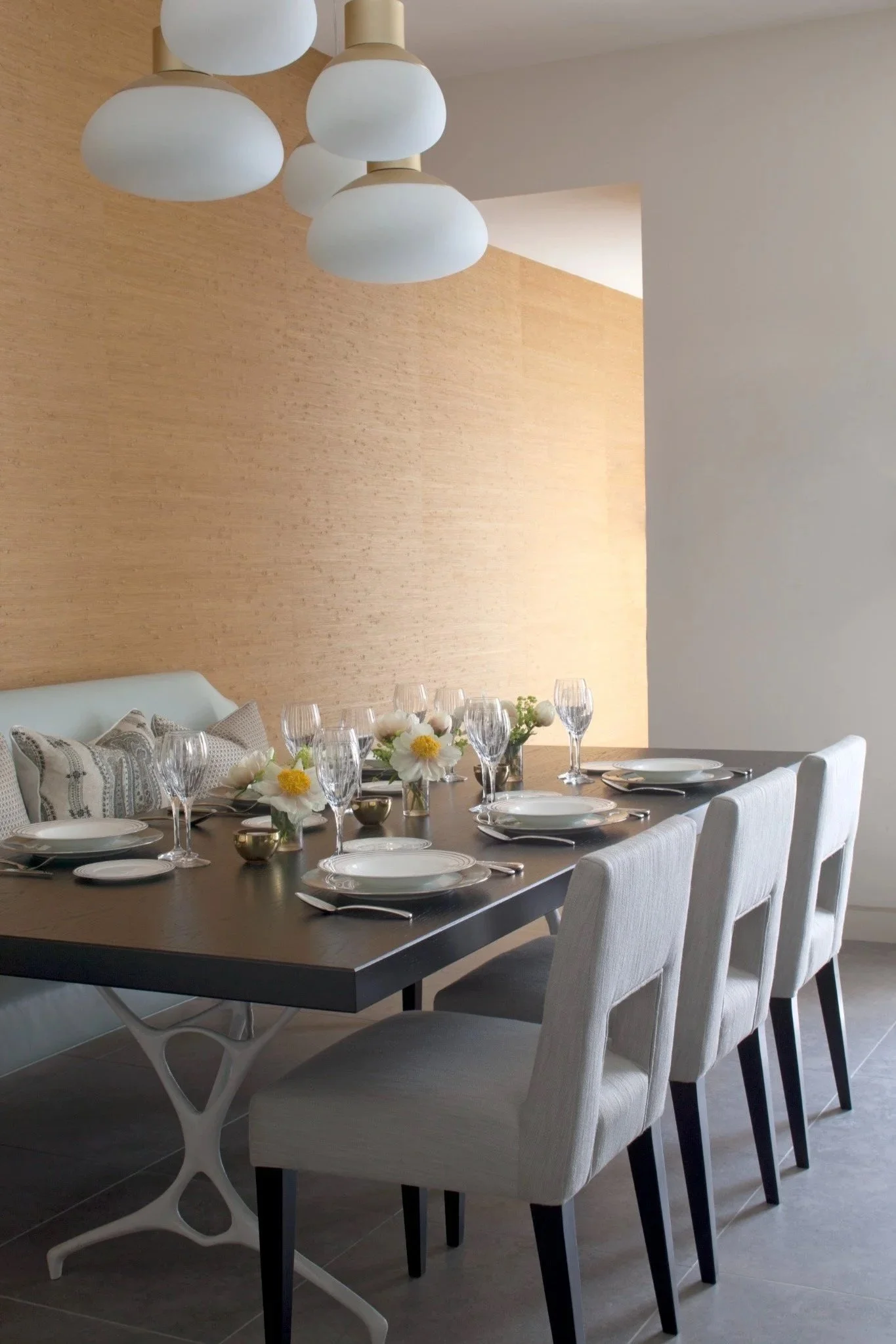
Photography: Richard Waite
Cohesion does not require every room to match. It comes from a consistent order of proportion, material and judgement that allows individual rooms to keep their own atmosphere.
A cohesive interior does not require the same colour or finish in every room. Repetition without judgement can make a house feel less designed, as though one successful decision has been copied until it loses meaning.
Cohesion comes from a consistent way of making decisions, in which proportions relate and materials return with variation. The rooms feel as though they belong to the same household even when their purposes and atmospheres differ.
Begin with the architecture and sequence
The house already contains an order. Entrances, stairs, corridors, openings and changes of ceiling height establish how rooms are encountered. I begin by identifying which spaces need continuity and which benefit from a distinct mood.
An entrance may prepare the eye for the rooms beyond without revealing their entire palette, and bedrooms can become quieter without appearing to belong to another project. I explore how individual rooms are approached in room-by-room design.
This sequence matters more than matching samples. A beautiful room reached through an unrelated transition can feel isolated, while modest material continuity across a threshold can make two different rooms belong together.
Establish a hierarchy of rooms
Not every room needs the same visual intensity or investment. Decide where the house should carry its principal gestures. It may be an entrance, living room, dining room or principal suite. Supporting rooms can be calmer while sharing the same standard of proportion and detail.
Without hierarchy, every pendant and stone competes to be memorable. The result can be expensive and restless. A whole-home scheme needs quiet passages as much as focal points.
Repeat a material with purpose
Repetition works when a material performs a related role. A timber may appear as joinery in one room and a furniture frame in another. A metal finish may connect hardware and lighting without requiring every fitting to match exactly.
The repetition should be recognisable without becoming a catalogue system. Different exposure and use may require the material to change. The relationship matters more than absolute uniformity.
Use colour as a progression
A whole-house palette is not necessarily one set of paint cards. It can move from lighter public rooms to more enveloping private spaces, or allow one colour to appear in several strengths and materials.
Daylight changes the result. The same neutral can feel cool in one room and warm in another. Colour should be judged in place and alongside timber, stone, fabric and art. My earlier article Colour Is a Relationship considers that interaction in more detail.
Let furniture carry continuity
Furniture can connect rooms through scale and line rather than matching suites. Curved forms may recur against more architectural pieces, and a consistent degree of tailoring can hold together objects from different periods.
I also consider the spaces between furniture. Similar generosity of circulation and a repeated relationship between seating and rugs can make rooms feel related even when their colours differ.
Coordinate lighting across different atmospheres
The lighting language should respond to each room while maintaining a clear standard of warmth and control. A kitchen requires precise task light, while a living room benefits from several lower sources.
Decorative fittings do not need to come from one family. Their scale and material presence should make sense in the same house. Lighting becomes cohesive when it supports a common understanding of how rooms should feel after dark.
Make room for existing pieces and different periods
A personal home rarely begins with an empty inventory. Art and inherited furniture can introduce histories that do not match the new scheme. They should not be forced into uniformity.
My earlier article The Discipline of Mixing Old and New explores this directly. Across a whole home, the important decision is where each piece has enough authority and enough space. Continuity comes from the composition around it.
Record the decisions that should remain consistent
As the project develops, schedules and samples create a reference for repeated finishes and dimensions. This prevents later rooms from drifting simply because they were resolved at another time.
The record should not turn the design into a rigid kit. It protects the underlying rules so deliberate exceptions can be recognised as exceptions.
A cohesive house feels settled because no room is trying to prove it belongs. The connection lies in the scale of the furniture and the judgement behind each change of atmosphere.
If your home needs a complete furnishing or interior scheme rather than a series of unrelated rooms, contact the studio to discuss a whole-home brief.