
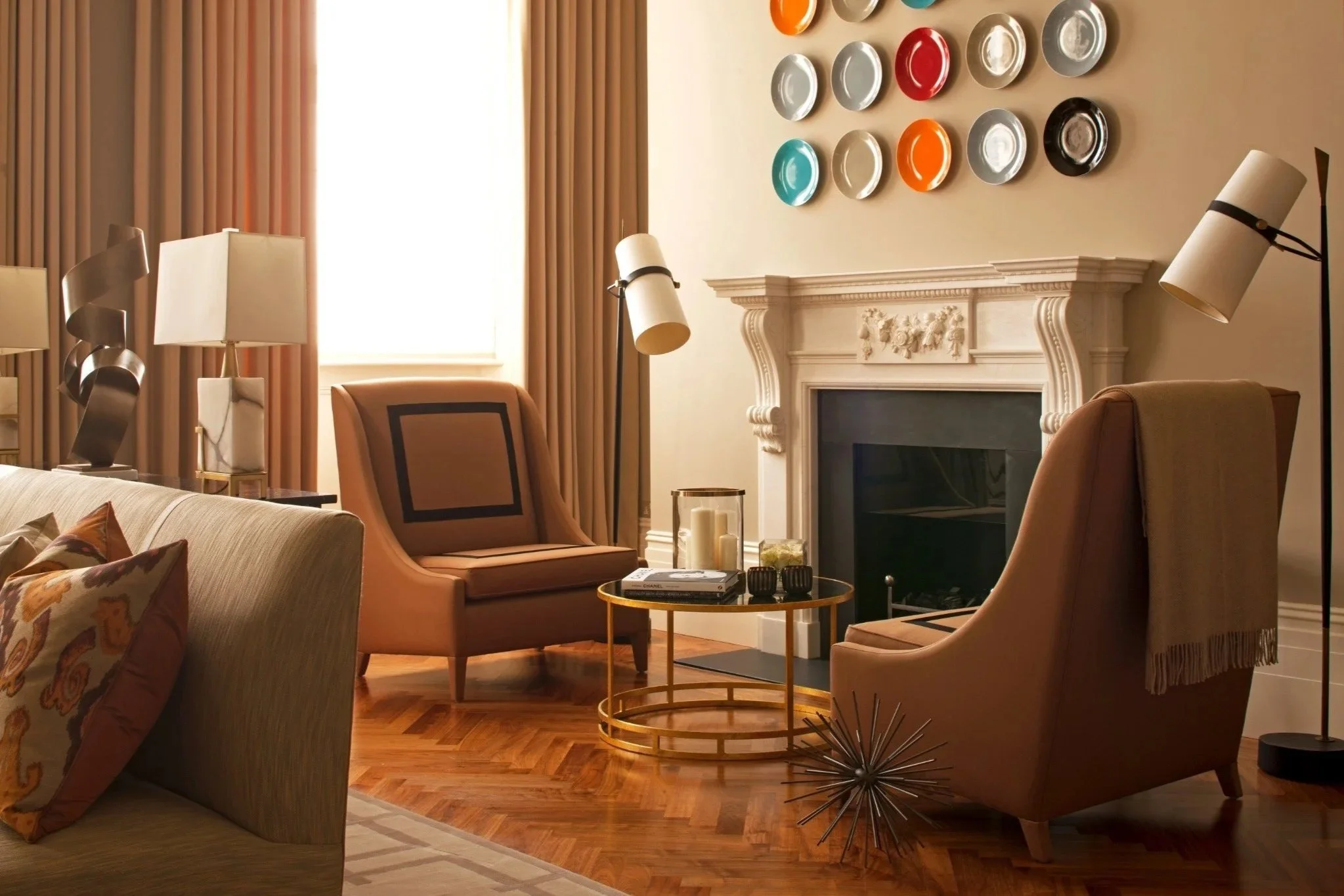
Living room from Artful Geometry. Its character comes from relationships between colour, furniture, art and existing architecture rather than one fashionable object.
Taste is not a list of approved objects. It develops through attention: noticing proportion, comparing rooms, understanding materials and learning why one decision continues to feel right.
Good taste can be learned, although I would describe the process as developing judgement. It is less about memorising which designers or periods are approved and more about understanding relationships: why one chair sits comfortably in a room while another seems too important for it, or why a colour that looked restrained on a sample becomes insistent across four walls.
Experience helps because it supplies comparisons. Attention matters more because it turns those comparisons into understanding.
Look at complete rooms rather than isolated objects
An object can be beautiful and still be wrong for a particular interior. When studying a room, look at how the pieces relate in height and visual weight. Notice the quieter furniture that allows a stronger object to register, and pay attention to the amount of empty wall and floor.
This shifts the question from “Do I like that sofa?” to “What is that sofa doing here?” The answer may concern scale, comfort, colour or the way its line responds to the architecture. My earlier article Reading a Room for Proportion develops this way of looking in greater depth.
Compare examples closely
Taste becomes more precise when similar things are compared. Look at two timber finishes in the same light, or sit in chairs with different seat depths, and compare rooms that use the same colour with and without success, asking what changed.
Photographs are useful, but physical experience teaches qualities the image removes: texture, weight, reflection, sound and comfort. A showroom can help if you examine the construction and scale rather than accepting the display as a complete answer for your own home.
Learn a useful vocabulary
You do not need professional terminology to have a valid response, although a more precise vocabulary helps explain it. “Too cold” may refer to colour, material, light or a lack of softness. “Too formal” may be caused by the distance between chairs or the absence of anything personal.
Naming the cause makes preference easier to discuss. It also prevents one disliked example from becoming a rule. A client who believes they dislike blue may be responding to a particular blue under a particular light. Colour Is a Relationship explains why the context matters.
Study what continues to interest you
Saved images often accumulate faster than they are understood. Review them after time has passed, noticing which rooms still hold your attention and which now feel attached to a particular moment. Look for repeated qualities rather than repeated products.
The pattern may concern atmosphere, such as rooms with depth or a mixture of old and new. It may concern furniture, perhaps low seating or a preference for objects that show the hand of a maker. These recurring responses begin to describe a personal direction.
Practise editing
Judgement develops through removal as much as selection. A room with several strong ideas may need one of them to leave, and a collection becomes more visible when it is grouped and given space.
Editing is difficult because each choice may be good on its own. The work is to decide which choice serves the room and which merely asks for attention. This is also where a designer can be useful: not as an arbiter of correct taste, but as someone able to show the consequences of keeping everything.
Understand why guidance matters
Clients hire an interior designer because a house requires thousands of related decisions, many involving scale, construction and lead time, which are difficult to test alone. A lack of taste rarely has anything to do with it.
The designer should widen the field and help the client make more confident choices. The Responsibility to Guide sets out that obligation. Good guidance should make the result more particular to the client, not more recognisable as the designer's house.
Accept that taste changes
Judgement is not a fixed identity. Travel, art, architecture, age and the experience of living with objects can change what feels convincing. A home should allow this development without being rebuilt around each new interest.
Durable decisions tend to have reasons beyond novelty, because their scale is right or because they support a real routine. They can remain even as the objects around them change.
The next article considers how to create a unique interior without following design trends. The answer begins with the same habit: looking closely enough to know why you respond.
If you want to develop a more confident direction for a complete home, contact the studio to discuss an interior decoration or furnishing commission.