
Photography: Richard Waite
A bathroom reveals its quality most clearly at seven in the morning. The room is no longer an immaculate composition of stone and fittings. Water is running, mirrors are beginning to fog, drawers are open, and two people may be moving through different routines at once. The planning either absorbs that pressure or turns an ordinary hour into a series of small negotiations.
The familiar idea of a luxury bathroom often begins with visible abundance: generous dimensions, exceptional stone, a freestanding bath and carefully chosen fittings. These elements can make a beautiful room, but they do not determine whether it is easy to use. That depends on the order in which the body moves, where everyday objects land, and whether two routines can unfold without repeatedly interrupting one another.
Plan the morning before the materials
The sequence begins before the basin. The route from bed to bathroom should feel direct, without unnecessarily exposing the room to a corridor, dressing room or adjoining bedroom. At night, low-level light should make that journey legible without the glare required for shaving or applying make-up. Doors, windows and mirrors all affect privacy, especially when more than one person uses the room.
A useful test is to observe the first ten minutes of the day. Where are glasses or a watch placed? Can a shower be started without standing under cold water? Is a towel within reach before anyone steps onto the floor? Can one person leave while the other remains at the basin? These questions reveal more about the plan than the width of the vanity or the price of the tapware.
This is why bathroom planning belongs within the wider spatial design and renovation of a home. The room is connected to the bedroom, dressing area, circulation and services around it. Resolving it in isolation can create an impressive bathroom that makes the adjoining suite less comfortable.
Two basins do not guarantee two routines
Twin basins are often treated as the obvious answer for a shared bathroom. They help only when each person also has usable surface, a mirror, power, storage and a towel within easy reach. Otherwise, the room doubles one fitting while leaving the same points of conflict unresolved.
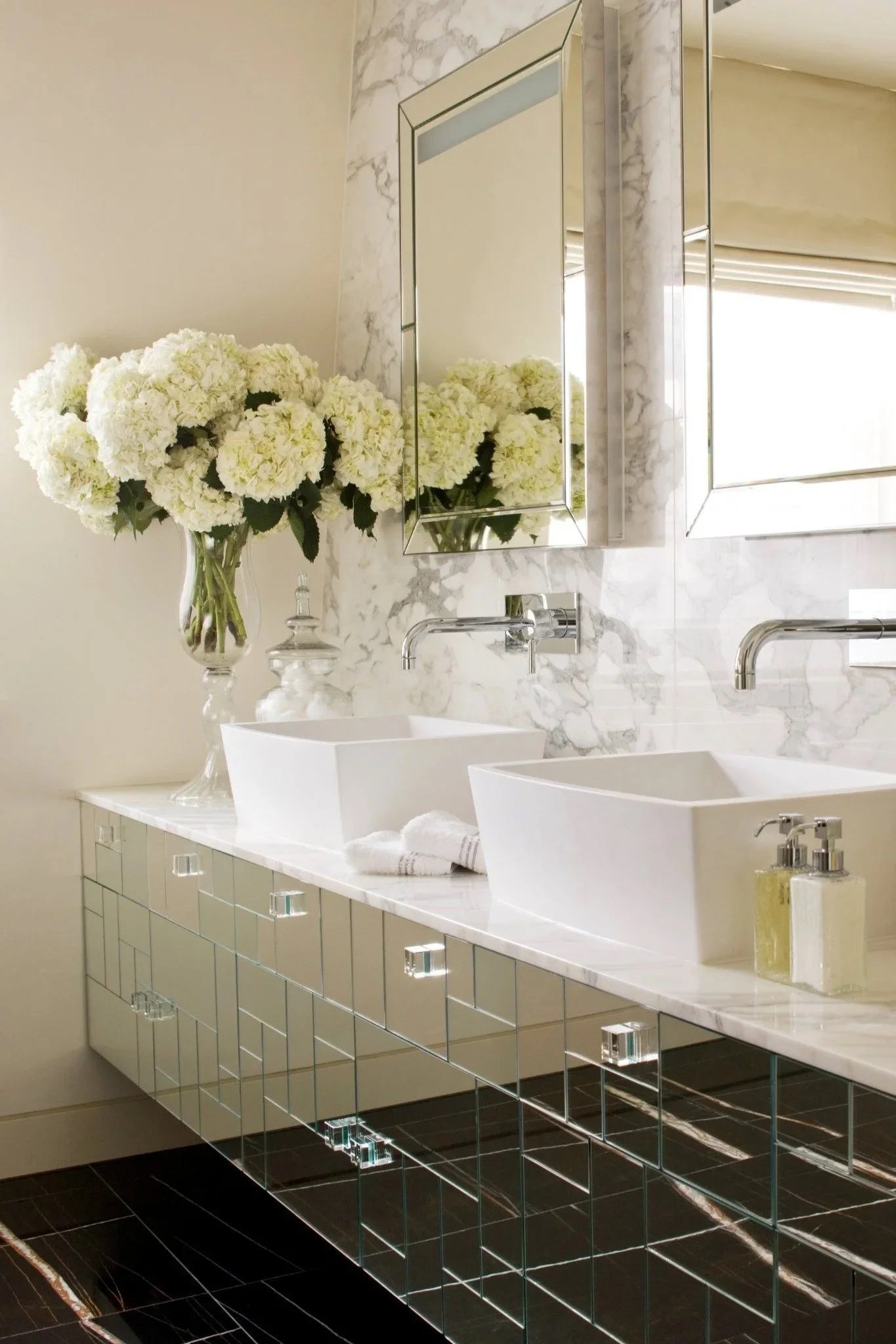
The primary bathroom in Modern Heirloom uses twin square basins, mirrored cabinetry and a continuous marble surface to create two parallel zones. The symmetry gives the room formality, but its practical value lies in allowing the shared wall to hold reflection, storage and preparation together. A large vanity earns its space when it supports simultaneous use rather than merely filling an elevation.
A dry surface is particularly important. The few things used every morning need somewhere to rest without crowding the basin or sitting in pooled water. A watch, a pair of glasses and an electric toothbrush require different kinds of storage and access. Planning those details does not diminish the elegance of the room. It protects it from the improvised solutions that arise when daily life has nowhere to go.
The wet area is a sequence, not a feature
The shower and bath are often designed as visual events. Their real success depends on less photogenic decisions: where the controls sit, how water is contained, where the towel waits, and whether every surface can be cleaned and maintained.
Shower controls should be accessible before anyone stands beneath the water. A niche should suit the products that will actually occupy it rather than an idealised collection of identical bottles. The distance to a towel rail matters, as do the direction of a door, the warmth of the floor and the location of a bench for anyone who needs one. A bath requires enough room around it for cleaning and safe movement; placing it close to a wall for the sake of a dramatic silhouette can create a narrow strip that is almost impossible to maintain.
Drainage, falls and ventilation are technical decisions, yet they determine whether the bathroom dries easily or retains evidence of every use throughout the rest of the day. In Brisbane's humid climate, extraction cannot be treated as a background specification. It affects comfort, mirrors, joinery, finishes and the room's long-term condition.
Lighting and storage should follow frequency
One lighting scene rarely suits a bathroom well. Soft light may be enough at night, while grooming requires even illumination on the face without shadows cast from above. General light, task light and low-level guidance should be separately controllable so the room can change with the hour.
Storage works on the same principle. The objects used every morning should be kept close at hand. Refills, medicines, cleaning supplies and occasional appliances can be stored deeper in the room, provided they remain easy to find and maintain. The aim is not to hide all evidence of life. It is to prevent the room from asking its users to unpack and repack themselves each day.
Materials enter the discussion once these relationships are understood. Stone, timber, metal and plaster must withstand water, cleaning and touch in the places where each will be used. A beautiful material cannot compensate for poor task lighting, an exposed power point or a junction that traps moisture. Its quality becomes more persuasive when it supports the room's routines rather than competing with them.
Luxury is an unhurried morning
The best bathroom need not imitate a spa. Its luxury lies in the absence of friction: warm light where it is useful, privacy without awkwardness, a dry towel within reach, and enough room for two people to move without negotiating every step. It is one expression of a home designed to be lived in, not just admired, where practical ease supports rather than diminishes visual refinement.
At seven in the morning, no one is admiring the concept board. They are looking for a clear surface, the right drawer and a comfortable level of light. When those decisions are made well, the room feels calm precisely when it is least composed. That is a more lasting expression of luxury than any finish can provide on its own.
Daniel Kostiuc Interior Design is a luxury interior design studio based in Brisbane, offering residential interior design and interior decoration across Queensland, Australia and internationally. Services include new builds, renovations, and complete furnishing projects, including space planning, custom joinery, bespoke furniture, furniture selection, lighting, art, and accessories for high-end homes.